The Australian National Council on Drugs (ANCD) has launched a new website Tell Your Story encouraging those who use, have used, or are in any other way involved with alcohol and other drugs to write about their experiences. The purpose is to provide a platform for people to share their personal stories about drugs and alcohol.
The ANCD chairman Dr John Herron had this to say in the organisation's media release:, “This project is unique in that it seeks the real life experiences with drugs and alcohol from the public. We know already that some stories will inspire others, some will help others to understand that they are not alone and some will be thought provoking and revealing. I am also so pleased that the NGO sector will take on this important work to document and share the contemporary Australian experience with drugs and alcohol. Too often it is a discussion that we fear and try and hide, when the better approach is to be open about our collective experiences. Only then can we fully understand this complex aspect of our lives”
Workers and employers are also encouraged to leave stories. Stories are moderated and may be edited to ensure no personal details sneak through and that offensive language is removed. It may take a week for a story to be available on the site.
The stories are freely accessible; there is no log in process.
Visit the Tell Your Story Website here
or read the full media release here.
Another Scottish site that serves a similar function from a mental health perspective is Write to Recovery (brought to our attention by Michelle, Brisbane CAFSS coordinator. Thanks, Michelle!). This site also allows free access to stories and has the additional feature of providing writers with tools to help with the writing process.

The official blog of the Drug ARM Australasia, Mental Health Association QLD, and Australian College of Community Services' library.
Thursday, 25 September 2014

Thursday, 11 September 2014
Two readings for your professional knowledge
The following recently published items may be of professional interest:
Motivational interviewing for alcohol misuse in young adults. Cochrane Database of Systematic Reviews 2014
http://onlinelibrary.wiley.com/doi/10.1002/14651858.CD007025.pub2/pdf
Cochrane's review on the effectiveness of using motivational interviewing (MI) with young people using alcohol. 66 studies, with 17,901 participants, were included in the review. General findings were that MI was not significantly effective in preventing alcohol misuse. Although some of the findings were significant the relationship was not particularly strong. Several limitations of the studies included are discussed and these are worth reading before dismissing MI as an intervention.
Sexual health and relationships in young Aboriginal and Torres Strait Islander people: results of the first Australian study of knowledge, risk practices and health service access for sexually transmissible infections (STIs) and blood borne viruses (BBVs) among young Aboriginal and Torres Strait Islander people: the goanna survey
https://nacchocommunique.files.wordpress.com/2014/07/final-goanna-report-july-2014.pdf
This is the first national survey of young Aboriginal and Torres Strait Islander people in relation to sexually transmissible infections (STIs) and blood borne viruses (BBVs) undertaken in Australia. There were 2,877 respondents aged 16-29yrs. Respondents indicated a good knowledge of STIs and BBVs. The report outlines reported sexual behaviour, licit and illicit drug use and injecting practices, STI testing and diagnosis.
Motivational interviewing for alcohol misuse in young adults. Cochrane Database of Systematic Reviews 2014
http://onlinelibrary.wiley.com/doi/10.1002/14651858.CD007025.pub2/pdf
Cochrane's review on the effectiveness of using motivational interviewing (MI) with young people using alcohol. 66 studies, with 17,901 participants, were included in the review. General findings were that MI was not significantly effective in preventing alcohol misuse. Although some of the findings were significant the relationship was not particularly strong. Several limitations of the studies included are discussed and these are worth reading before dismissing MI as an intervention.
Sexual health and relationships in young Aboriginal and Torres Strait Islander people: results of the first Australian study of knowledge, risk practices and health service access for sexually transmissible infections (STIs) and blood borne viruses (BBVs) among young Aboriginal and Torres Strait Islander people: the goanna survey
https://nacchocommunique.files.wordpress.com/2014/07/final-goanna-report-july-2014.pdf
This is the first national survey of young Aboriginal and Torres Strait Islander people in relation to sexually transmissible infections (STIs) and blood borne viruses (BBVs) undertaken in Australia. There were 2,877 respondents aged 16-29yrs. Respondents indicated a good knowledge of STIs and BBVs. The report outlines reported sexual behaviour, licit and illicit drug use and injecting practices, STI testing and diagnosis.
Friday, 5 September 2014
National child protection week
National Child Protection Week begins Sunday 7th September and you can visit the National Association for Prevention of Child Abuse and Neglect (NAPCAN) website for posters and resources to raise awareness around the week. There are several printable brochures available through the "Resource Hub" section of the website.
For further resources/reading on the topic see:
Outlines child and family sensitive practice and recommends alcohol and drug organisations :
The Australian Indigenous HealthInfoNet has links to health promotion and practice resources, and publications on family violence.
Gruenert & Tsantefski (2012) Responding to the needs of children and parents in families experiencing alcohol and other drug problems. Prevention Research Quarterly, 17.
We will have a display of resources in the library during the week. We'll also be looking at providing resources and information on the topic of child abuse and trauma to tie in with Blue Knot Day, on the 27th October.
For further resources/reading on the topic see:
ANCD Research paper:
From policy to implementation: child and family sensitive practice in the alcohol and other drugs sector. (2014) National Centre for Education and Training on AddictionOutlines child and family sensitive practice and recommends alcohol and drug organisations :
- Organisations be encouraged to review and, where appropriate, amend their policies to incorporate clear policies and guidelines on working from a child and family sensitive perspective.
- Alcohol and other drugs organisations and child welfare/protection services develop joint protocols and systems that facilitate information sharing about the wellbeing and safety of clients’ children.
- In the implementation of child and family sensitive practice, consideration be given to the evidence base for good practice, including the exemplars identified as part of this project.
- When developing and implementing child and family sensitive practice, alcohol and other drugs organisations identify and support champions who can be used to promote the implementation of child and family sensitive practice.
- Alcohol and other drugs organisations review and update their current training provision in relation to child and family sensitive practice and ensure that staff are provided with appropriate professional development opportunities.
- Alcohol and other drugs organisations review and update their clinical supervision guidelines to ensure that they include reference to child and family sensitive practice.
The Australian Indigenous HealthInfoNet has links to health promotion and practice resources, and publications on family violence.
Gruenert & Tsantefski (2012) Responding to the needs of children and parents in families experiencing alcohol and other drug problems. Prevention Research Quarterly, 17.
We will have a display of resources in the library during the week. We'll also be looking at providing resources and information on the topic of child abuse and trauma to tie in with Blue Knot Day, on the 27th October.
Thursday, 28 August 2014
What young people think about AOD issues

For the full report see:
Young people's opinions on alcohol and drug issues.
Some of the strong beliefs are reported by ANCD:
- Supporting access to drug treatment services, including drug withdrawal treatment and residential rehabilitation.
- Supporting harm reduction measures - over two-thirds supported needle and syringe programs, regulated injecting facilities, and the availability of pill testing equipment or kits
- Supporting government intervention only when a person's drug use is causing harm to someone else
- Supporting policies that help them to access accurate, balanced, relevant drug information and education; they would like to be free to make informed decisions about the risks, or benefits, of using drugs
- Supporting approaches to new and emerging psychoactive substances with regulation and opposing outright bans
- Supporting the legalization of personal use of cannabis, with a preference for education and treatment being the first line response by governments.
- Opposing measures that are designed to restrict alcohol availability, including restricted trading hours, increased prices and reduced numbers of outlets selling alcohol
- Opposing the use of sniffer dogs in public places
Thursday, 14 August 2014
NCETA launches new AOD knowledgebase
The National Centre for Education and Training on Addiction has just launched a new website
The site has four knowledge areas; alcohol, cannabis, pharmaceuticals, and methamphetamines. At present only the "alcohol" section of the website has been finished.
The information presented is intended for clinicians, researchers, policy makers and the general public. All of the information has been presented in an easy-to-read, easy-to-navigate question and answer format. They have evaluated and analysed a number of key resources to provide the answers, meaning that the end user does not need to wade through the huge amounts of information available and try to critic the information themselves. The information provided in the answers is brief and references are included as a separate page.
The Alcohol Section of the Knowledgebase contains more than 130 frequently asked questions (FAQs) about:
· Consumption patterns
· Alcohol use and the workplace
· Alcohol-related harms
· The impact of alcohol consumption on crime and violence
· Treatment
· Young people
· Consumption patterns
· Alcohol use and the workplace
· Alcohol-related harms
· The impact of alcohol consumption on crime and violence
· Treatment
· Young people
It is envisaged that the website will be updated frequently to ensure the information is always current.
Friday, 8 August 2014
Measuring global emotion
The CSIRO along with the Black Dog Institute have begun a project mapping emotions expressed in content posted on Twitter. The "We feel ..." project allows you to search by emotion, region and date. By clicking through the emotions you are able to see the words that are used to categorise Tweets.
The explorer tab (the first page that opens) provides a nice visual representation of your search...

whilst the table builder allows you to conduct a more refined search...

The explorer tab (the first page that opens) provides a nice visual representation of your search...
whilst the table builder allows you to conduct a more refined search...
There are yet to be any papers released on the data, but the site is free, relatively easy to use, and an interesting insight into global emotion.
Winter School Conference Day 3 - What the Tweets told us
If you want a wrap up of all the tweets about Winter School in a lovely package with great explanations you can visit the Lives Lived Well storify site:
https://storify.com/LivesLivedWell/2014-australian-winter-school
Here's just a brief insight into what was happening on the third day (2nd day of conference presentations) at Winter School.
Waste water analysis
Professor Wayne Hall presented on waste water analysis as a means of determining drug use.


If this is a topic that you are interested in, you may like to read:
Trends & Issues in Crime and Criminal Justice report "Measuring drug use patterns in Queensland through waste water analysis"
Novel psychoactive substances
Panel discussion on novel psychoactive substances


For further information consult




https://storify.com/LivesLivedWell/2014-australian-winter-school
Here's just a brief insight into what was happening on the third day (2nd day of conference presentations) at Winter School.
Waste water analysis
Professor Wayne Hall presented on waste water analysis as a means of determining drug use.
If this is a topic that you are interested in, you may like to read:
Trends & Issues in Crime and Criminal Justice report "Measuring drug use patterns in Queensland through waste water analysis"
Hall, W., Prichard, J., Paul Kirkbride, R. B., Thai, P. K., Gartner, C., Lai, F. Y., ... & Mueller, J. F. (2012). An analysis of ethical issues in using wastewater analysis to monitor illicit drug useadd_3887 1767.. 1773. Addiction, 107, 1767-1773.
http://www.uqccr.uq.edu.au/media/80944/12.09.11_-_an_analysis_of_ethical_issues_in_using_wastewater_analysis.pdfNovel psychoactive substances
Panel discussion on novel psychoactive substances
For further information consult
Bruno, R., Poesiat, R., & Matthews, A. J. (2013). Monitoring the Internet for emerging psychoactive substances available to Australia. Drug and alcohol review, 32(5), 541-544. Available on request from the library.
The challenge of new psychoactive substances 2013 report from the United Nations Office on Drugs and Crime.
Health promotion stream
For further info read the FARE report "Health professionals' use of Australian Alcohol Guidelines: Baseline survey: Report findings July 2014"
Alcohol related violence
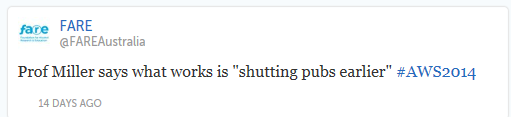
Professor Miller, presenter on this topic, is a frequent contributor to The Conversation, and you can read articles by him related to alcohol fuelled violence here, here, and here
Social marketing campaigns
For further reading:
Jones, S. C., & Magee, C. A. (2011). Exposure to alcohol advertising and alcohol consumption among Australian adolescents. Alcohol and Alcoholism, 46(5), 630-637.
Hall, D. V., Jones, S. C., & Hoek, J. (2011). Direct to consumer advertising versus disease awareness advertising: Consumer perspectives from down under. Journal of Public Affairs, 11(1), 60-69.
If you attended Winter School and would like to share some of your learnings please comment below or contact the library about contributing a blog post.
Subscribe to:
Posts (Atom)